Amusement park engineering has evolved dramatically over the last century, transforming simple mechanical carousels into towering feats of structural dynamics. Modern attractions prioritize visual immersion alongside kinetic thrills. Guests no longer settle for mere centrifugal force; they demand sweeping vistas of skylines, coastlines, and sprawling fairgrounds. Evaluating the optical advantage between vertical aerial rides and traditional ground-level spinners requires examining structural elevation, rotational velocity, and unobstructed sightlines. Both ride archetypes deliver distinct visual experiences depending on park topography and engineering design.
Architectural Elevation of a Swing Tower
Verticality defines the primary optical advantage of a modern swing tower. Unlike conventional flat rides anchored near ground level, these colossal structures propel passengers anywhere from forty to over one hundred meters into the troposphere. At such altitudes, surrounding park infrastructure—including roller coaster lift hills, Ferris wheels, and dense foliage—drops far below the rider’s horizon line. This immense elevation eliminates foreground visual clutter. Passengers experience a true three-hundred-sixty-degree panorama uninterrupted by nearby architectural obstructions.
The engineering mechanics behind this altitude rely on a central steel pylon housing counterweights and heavy-duty hoist cables. As the gondola ascends, the passenger’s field of view expands exponentially. Atmospheric perspective takes over. Distant landmarks, urban skylines, and natural bodies of water become clearly discernible. Furthermore, the structural footprint remains remarkably compact despite the towering vertical reach. Park planners frequently position these installations at the highest topographical elevation within a venue to maximize sightline efficiency. The resulting vantage point mimics an observation deck, yet introduces dynamic radial motion that shifts the horizon continuously.
Optical Dynamics of Classic Chair Swings
Traditional flat rides operate on an entirely different spatial plane, prioritizing low-altitude proximity and kinetic immediacy over stratospheric reach. A classic chair swing ride relies on a central telescoping or tilting column that lifts riders only a few meters off the boarding platform. Consequently, the visual experience remains intimately connected to the surrounding midway. Rather than surveying distant geographical horizons, passengers observe the vibrant tapestry of the park environment directly beneath their feet.
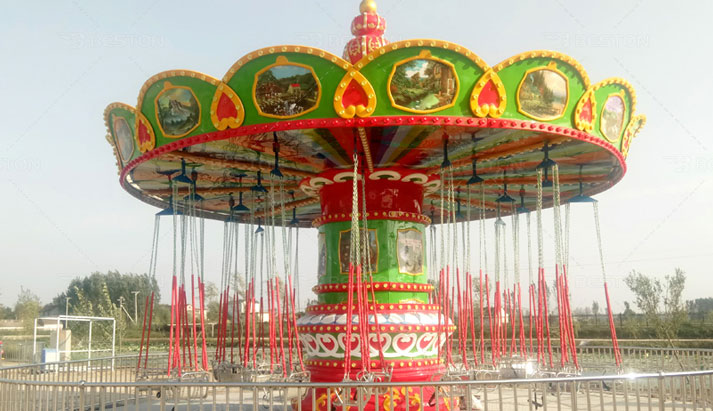
This lower trajectory creates a distinct parallax effect. Nearby structures, pedestrian pathways, and adjacent attractions rush past the peripheral vision at high angular velocity. While a classic chair swing cannot offer unobstructed aerial vistas beyond the park perimeter, it excels at delivering a kinetic, ground-hugging perspective. The tilting crown mechanism, commonly found on wave swinger models, introduces a sinusoidal vertical oscillation. Riders dip close to landscaped gardens and illuminated fountains before rising toward the canopy of surrounding trees. The visual appeal here is granular and dynamic, focusing on immediate architectural details rather than broad geographical expanses.
Engineering Sightlines with Beston Rides
Selecting the optimal attraction for visual impact depends heavily on park layout, zoning height restrictions, and target demographics. Manufacturers like Beston Rides engineer both towering vertical flyers and traditional wave swingers to accommodate diverse spatial constraints. When evaluating sightlines, structural engineers analyze sight-cone geometry, seating pitch, and restraint profiles. High-altitude towers utilize open-air, twin-seat gondolas suspended by high-tensile chains, ensuring that structural trusses never intrude upon the rider’s forward or lateral field of view.
Conversely, low-altitude models manufactured by Beston Rides emphasize ornate canopy artistry and perimeter illumination, turning the ride itself into a visual centerpiece for spectators on the ground. For riders, the seating angle is calibrated to tilt slightly outward under centrifugal load, directing the gaze naturally toward the horizon rather than the floor. Operators situated near scenic coastlines or dense metropolitan centers typically favor extreme verticality to capitalize on external landscapes. Parks nestled in flat, rural terrains often find that traditional models provide superior visual engagement by keeping riders immersed within richly themed internal environments.
Rotational Velocity and Visual Acuity
Sightline elevation means very little if excessive rotational speed blurs the surrounding landscape into an indistinguishable streak. Optical clarity during rotational flight depends on angular velocity and radial distance from the central axis. High-altitude towers generally operate at moderate revolutions per minute. Because the chain radius expands significantly at peak elevation, riders achieve substantial tangential speed while maintaining a relatively slow angular rotation rate. This mechanical balance allows the human eye to focus smoothly on distant landmarks, track moving objects, and appreciate sweeping panoramic transitions without inducing motion sickness or visual fatigue.
Traditional ground-level spinners operate with a much tighter rotational radius. To generate comparable lateral G-forces, the central hub must spin at a noticeably higher angular velocity. This rapid rotation accelerates the rate at which foreground objects cross the rider’s visual field. While exhilarating, this speed limits the brain’s ability to process fine details in the immediate vicinity. Riders perceive a vibrant kaleidoscope of colors and lights rather than a stable, contemplative vista.
Ultimately, vertical elevation secures the definitive advantage for pure panoramic viewing. High-altitude installations lift passengers well above visual obstructions and regulate rotational velocity to preserve optical clarity across vast distances. Classic ground-level models remain unmatched for kinetic energy and immersive midway interaction, yet they cannot replicate the commanding, unobstructed horizon offered by their towering counterparts.