
Vertical attractions serve as primary visual anchors for modern theme parks and regional entertainment centers. When planning a skyline expansion, operators frequently evaluate two distinct engineering architectures: rotational aerial carousels and vertical free-fall systems. Both structures command attention from miles away, yet their mechanical footprints, guest throughput metrics, and demographic appeal differ substantially. Selecting the optimal centerpiece requires a granular analysis of structural dynamics, foundation requirements, and long-term operational expenditures.
Mechanical Architecture and Kinematic Profiles of a Swing Tower
A swing tower relies on rotational momentum and controlled vertical elevation to deliver a sustained aerial experience. The central mast houses a counterweight system and heavy-duty hoist cables that lift a rotating crown assembly to operational altitudes often exceeding 60 meters. As the carriage ascends, variable-frequency drives initiate radial rotation, causing the suspended passenger gondolas to flare outward under centrifugal force.
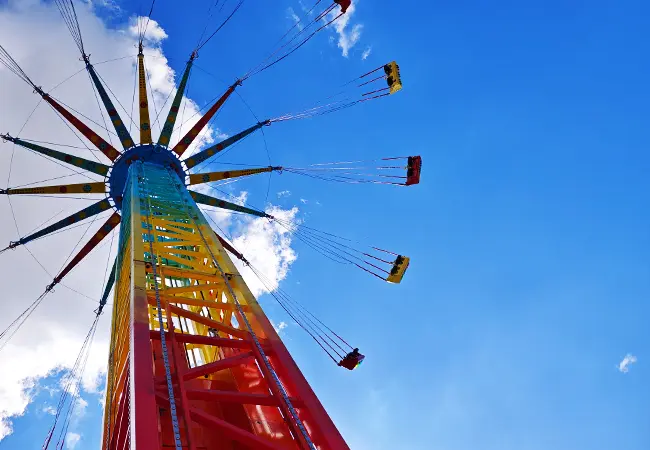
This kinematic profile prioritizes duration over sudden acceleration. Riders experience mild positive G-forces coupled with panoramic visibility, making the attraction accessible to a broad demographic spectrum. From a structural engineering standpoint, wind-load tolerances represent the primary operational constraint. High-altitude crosswinds induce harmonic oscillation in the suspension cables, requiring integrated anemometers to trigger automated descent protocols when wind speeds exceed preset safety thresholds. The mechanical wear remains relatively uniform across the hoist sheaves and slewing bearings, contributing to predictable preventative maintenance schedules.
Gravitational Dynamics and Braking Systems in a Drop Tower
In contrast to rotational flight, a drop tower is engineered around abrupt vertical acceleration and controlled deceleration. The ride carriage ascends a rigid vertical lattice or tubular column via winches or linear synchronous motors. Upon reaching the apex, a pneumatic or electromagnetic release mechanism disengages the carriage, initiating a near-free-fall descent that briefly subjects passengers to microgravity conditions.
The defining engineering feature of this attraction class is its deceleration apparatus. Modern installations utilize permanent-magnet eddy-current brakes rather than friction pads. As copper fins mounted on the carriage pass through banks of rare-earth magnets along the lower mast, opposing magnetic fields generate smooth, fail-safe braking force without physical contact or electrical power dependency. Because dynamic shock loads transfer directly into the mast during carriage arrest, civil engineering requirements demand deeper caisson foundations and reinforced concrete pads compared to rotational towers of equivalent height.
Evaluating Throughput, Footprint, and Spatial Integration
Site selection within an existing park layout depends heavily on dynamic envelope clearances. While a free-fall column requires a compact ground footprint, a rotational aerial ride demands a wide cylindrical clearance zone to accommodate the outward flare of its seats at maximum rotational velocity. Nearby pathways, retail kiosks, and adjacent ride envelopes must remain entirely outside this radial perimeter.
Capacity metrics also diverge sharply between the two ride types. Rotational towers typically feature single-cycle durations lasting between two and three minutes, accommodating 24 to 48 passengers per dispatch depending on gondola configuration. Free-fall towers operate on shorter cycle times, often completing an ascent and drop sequence within 60 to 90 seconds. While per-cycle seating may be lower on single-column units, rapid dispatch intervals yield competitive hourly theoretical capacity. Operators integrating Beston amusement rides into high-density park zones often balance these metrics by pairing a high-capacity rotational centerpiece with compact flat rides to distribute queue congestion evenly across the midway.
Capital Expenditure and Lifecycle Maintenance Considerations
Financial modeling for vertical installations extends well beyond initial equipment procurement. Heavy crane mobilization represents a substantial portion of installation costs for both systems, particularly when erecting modular mast sections above 50 meters. However, ongoing operational expenses diverge based on component complexity.
Rotational structures require routine inspection of wire ropes, swivel joints, and passenger restraint harnesses subjected to continuous lateral sway. Conversely, vertical fall systems concentrate mechanical stress on the apex release latch, guide wheels, and anti-rollback assemblies. Sourcing durable structural components from established manufacturers such as Beston amusement rides ensures that alloy steel masts and redundant programmable logic controllers meet stringent international compliance standards, including EN 13814 and ASTM F2291. Furthermore, energy consumption profiles differ; regenerative drives on modern vertical towers can recapture kinetic energy during braking, whereas rotational systems draw steady power throughout the sustained spin cycle.
Strategic Alignment for Park Master Planning
Choosing between rotational elevation and vertical free-fall ultimately hinges on a venue’s target demographic and existing attraction portfolio. Family-oriented parks seeking high visual impact without extreme physiological intensity benefit from the inclusive appeal and extended ride cycle of an aerial carousel. Thrill-focused destinations aiming to capture adolescent and young adult market segments gain stronger repeat ridership from the visceral adrenaline spike of a vertical plunge. By aligning structural footprint, foundational engineering, and demographic targeting, operators can maximize return on investment while establishing an unmistakable architectural landmark.